
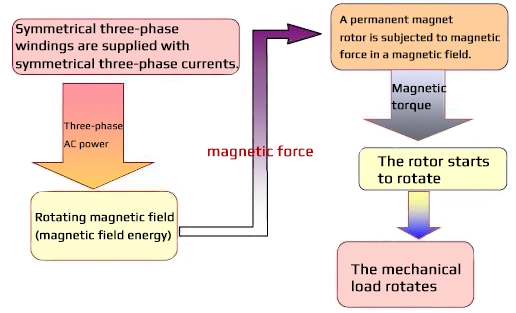
A rotating magnetic field is generated by connecting three-phase symmetrical alternating current to the three-phase windings of the motor stator.
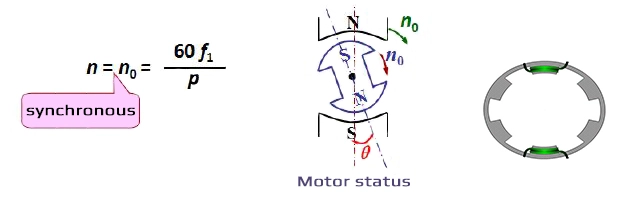
Based on the principle that opposite poles attract and like poles repel, regardless of the initial relative positions of the stator rotating magnetic poles and the permanent magnet poles, the stator rotating magnetic poles will always pull the rotor to rotate synchronously due to magnetic force.
The speed of a synchronous motor can be expressed as:
Features of permanent magnet synchronous motor
(1) Small size, light weight, and high power density
(2) High efficiency and wide high-efficiency range
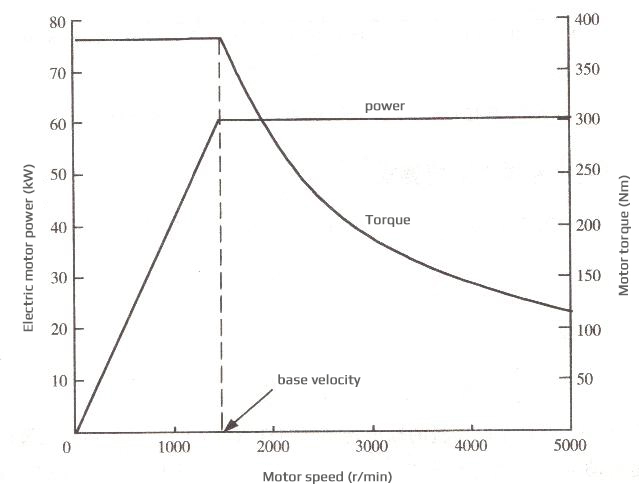
(3) Wide constant power range
(4) High safety and comfort
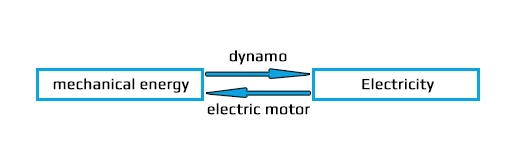
(5) Effective energy recovery
Features of permanent magnet synchronous motor
The drive motor is controlled by the drive motor controller according to the requirements of the vehicle controller. Based on the vehicle parameters, the rated power, peak torque, and peak speed of the drive motor can be preliminarily determined, allowing for initial selection.
New energy permanent magnet synchronous motors generally operate on an S9 duty cycle (load and periodic non-periodic duty cycle). In actual vehicle development, considering cost, time, and stability, priority is given to selecting drive motors whose performance has been proven.
| Work system | start | Unloaded | Thermal stability constant load | Non-thermal steady load | Variable speed and load braking | Energy cut-off | Periodic | |
|---|---|---|---|---|---|---|---|---|
| Continuous work schedule | S1 | ✓ | ||||||
| Short-time work | S2 | ✓ | ||||||
| Intermittent periodic work system | S3 | ✓ | ✓ | ✓ | ||||
| Including intermittent periodic duty system for startup | S4 | ✓ | ✓ | ✓ | ✓ | |||
| Including intermittent duty cycle of electric braking | S5 | ✓ | ✓ | ✓ | ✓ | ✓ | ||
| Continuous periodic duty | S6 | ✓ | ✓ | ✓ | ||||
| Including continuous cycle duty with electric braking | S7 | ✓ | ✓ | ✓ | ✓ | |||
| Including continuous cycle duty with variable speed and load | S8 | ✓ | ✓ | ✓ | ✓ | |||
| Non-periodic load and speed duty cycle | S9 | ✓ | ✓ | |||||
| Discrete constant load duty cycle | S10 | ✓ | ✓ | |||||
Work system division
Rated Power
During normal driving, a car primarily bears the resistance from air resistance, rolling resistance, acceleration resistance, and gradient resistance. The drive motor must meet the driving force requirements of the vehicle under various driving conditions.
The rated power of the drive motor needs to meet the maximum power demand for the vehicle’s sustainable operation. When the vehicle reaches its maximum target speed, the required rated power is the maximum rated power requirement.

Where:
PN—rated power of the drive motor, kW; ηT—mechanical efficiency of the power transmission system; mtest—test mass of the vehicle, kg; g—acceleration due to gravity, m/s²; f—rolling resistance coefficient; umax—maximum vehicle speed, km/h; ρ—air density, kg/m³; CD—air drag coefficient; A—frontal area, m²
Peak Speed
The maximum speed of the drive motor needs to be higher than the maximum target vehicle speed requirement.
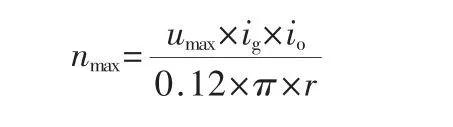
Where:
nmax—peak speed of the drive motor, r/min; ig—reduction ratio of the reducer; io—final reduction ratio; r—tire rolling radius, m
Peak Torque
Under all driving conditions, the driving force required by a car is greatest during acceleration and hill climbing.
The driving force required to climb a slope of gradient i at a vehicle speed ui can be obtained from the following formula.

Where:
Fi—driving force required for vehicle climbing, Nm; mmax—full load mass of vehicle, kg; a—gradient angle; ui—vehicle speed climbing, km/h
I. Basic parameters
| Bus Voltage Range (VDC) | 400-750 | Bus Terminal Voltage (VDC) | 540 |
| Rated Power (kW) | 60 | Rated Torque (Nm) | 318 |
| Peak Power (kW) | 100 | Peak Torque (Nm) | 850 |
| Peak Power Duration (s) | 50 | Peak Torque Duration (s) | 50 |
| Rated Speed (rpm) | 1802 | Peak Speed (rpm) | 4500 |
| Rated Current (A) | 120 | Peak Current (A) | 310 |
| Maximum Efficiency (%) | 96 | >85% Of The High-Efficiency Zone (%) | 85 |
| Peak Back EMF (VDC) Of Unloaded Line | 820 | Maximum Protection Speed (rpm) | 5400 |
Items marked in red are mandatory. Rated current, peak back EMF of unloaded line, and peak current are relevant factors in controller selection.
II. Heat dissipation parameters
| Cooling Water Inlet Temperature (°C) | ≤65 | Cooling Water Flow Rate (L/min) | ≥16 |
III. Other parameters
| Operating Ambient Temperature (°C) | -40~65 | Overheat Protection (°C) | 150 |
| Work System | S9 | Motor Steering | counterclockwise |
| Insulation Class | H | Protection Level | IP67 |
| External Dimensions (mm) | – | Weight (kg) | – |
External dimensions and weight affect motor structure and installation.

